
Naming stones
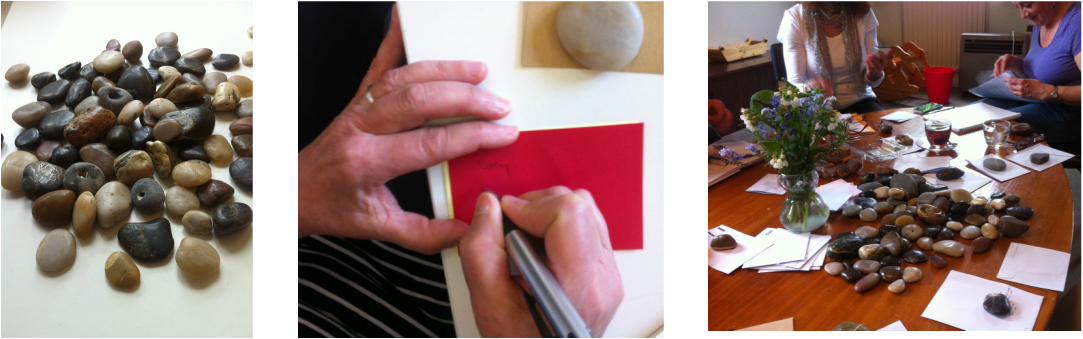
This is a 15-30 minute exercise for writers to work with others, to look closely at common objects, to handle them, to name them , to explore the allusive quality of names - and to write whatever may be prompted by their shape and surface, heft and texture, or that may be provoked by talking with others about their observations and associations.
FIRST ... working individually or in pairs, choose three stones from the pile. Handle them. Feel their weights and stroke their surfaces. Investigate their colours and markings. Think of their origins and potential. Why are you attracted to particular ones? How is each distinctive? What stories do they hold? How do such ordinary objects become special through their connections to memories of people, times and places? (Use geological terms below, if you wish.)
Now name the stones. Give each one at least three names. These might be descriptive:
Peep hole
Light side, dark side
Two face
... or they might be playfully allusive - names dredged up from memory or some other connection you may or may not be able to explain:
Spy
Earwax
Embryo
West country, born and bred
Wounded
Baldy
Downinthedumps
Twisted past
Victor
Robbie Smith
(these are all names invented by other writers doing this exercise)
Each pair or person writes each name on a slip of paper and places each slip in the relevant envelope. The relevant stone is then placed on top of the envelope. The pair or person passes their stones and envelopes to the person on their left. Each pair or person repeats the process with new stones: without looking at the previously devised names, each pair or person writes newly devised names on new slips of paper and places each inside the relevant envelopes, replacing the stone on top of the envelope afterwards.
Repeat the process a third time before each pair or person receives back their originally chosen stones and envelopes. Open the envelopes.
Group ‘introductions’ can now take place – a pair or person may like to ‘introduce’ a stone to each other – or to the whole group.
NEXT ... using however many of the ‘names’ to help her/him, each writer chooses one of the stones to write about for 10 minutes, including the stones in a narrative, poetry or other form of writing. This is an opportunity to write freely or to use the properties and associations of people, places, moods and foods in an original piece of imaginative writing.
FIRST ... working individually or in pairs, choose three stones from the pile. Handle them. Feel their weights and stroke their surfaces. Investigate their colours and markings. Think of their origins and potential. Why are you attracted to particular ones? How is each distinctive? What stories do they hold? How do such ordinary objects become special through their connections to memories of people, times and places? (Use geological terms below, if you wish.)
Now name the stones. Give each one at least three names. These might be descriptive:
Peep hole
Light side, dark side
Two face
... or they might be playfully allusive - names dredged up from memory or some other connection you may or may not be able to explain:
Spy
Earwax
Embryo
West country, born and bred
Wounded
Baldy
Downinthedumps
Twisted past
Victor
Robbie Smith
(these are all names invented by other writers doing this exercise)
Each pair or person writes each name on a slip of paper and places each slip in the relevant envelope. The relevant stone is then placed on top of the envelope. The pair or person passes their stones and envelopes to the person on their left. Each pair or person repeats the process with new stones: without looking at the previously devised names, each pair or person writes newly devised names on new slips of paper and places each inside the relevant envelopes, replacing the stone on top of the envelope afterwards.
Repeat the process a third time before each pair or person receives back their originally chosen stones and envelopes. Open the envelopes.
Group ‘introductions’ can now take place – a pair or person may like to ‘introduce’ a stone to each other – or to the whole group.
NEXT ... using however many of the ‘names’ to help her/him, each writer chooses one of the stones to write about for 10 minutes, including the stones in a narrative, poetry or other form of writing. This is an opportunity to write freely or to use the properties and associations of people, places, moods and foods in an original piece of imaginative writing.
